

Blog
Does Thicker Sublimation Paper Improve Print Quality?


When choosing sublimation transfer paper, buyers often assume that a higher GSM means better print quality. But is thicker sublimation paper really better?
Not necessarily. Paper thickness is only one factor affecting sublimation results. Coating quality, ink absorption, drying speed, transfer efficiency, printer compatibility, and the type of substrate all play important roles.
What Does GSM Mean in Sublimation Paper?
GSM means grams per square meter and is commonly used to describe the weight of Sublimation Paper.
A higher GSM paper is generally heavier and often has a stronger paper base. However, GSM should not be confused with coating quality or transfer performance. A well-engineered lower-GSM paper can outperform a heavier paper if its coating is better matched to the ink and printing process.
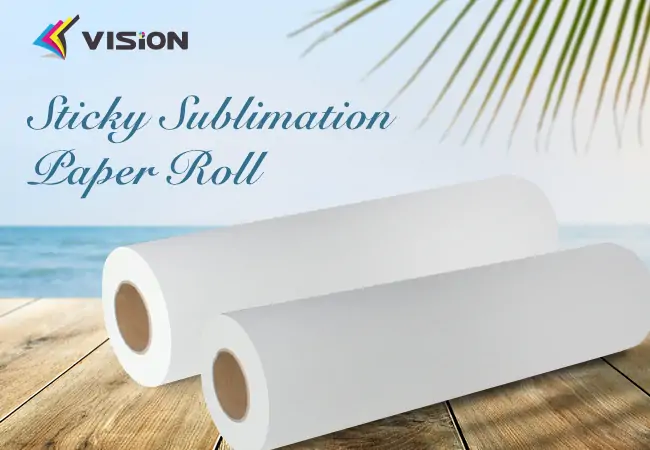
sticky sublimation paper rolls
What Are the Advantages of Thicker Sublimation Paper?
Higher-GSM sublimation paper can offer several practical advantages.
First, it can provide better dimensional stability during printing and heat transfer. This is useful for high-ink-volume designs where a lighter paper may curl or become difficult to handle.
Second, a suitable coating can hold a relatively high amount of sublimation ink while controlling penetration. This can help maintain strong colors and efficient dye release during heat transfer.
However, more ink retention is not always better. For certain hard substrates or applications where excessive ink can contribute to ghosting or image softness, a lighter paper may perform better. For designs with high ink coverage, a heavier sublimation paper may provide better handling and ink management, while thinner paper can be a suitable choice for certain rigid substrate applications.
Does Thicker Paper Produce Sharper Images?
Not automatically.
Print sharpness is influenced by several variables:
-
Sublimation paper coating
-
Ink absorption and drying behavior
-
Printer resolution and printhead condition
-
ICC or color profile
-
Ink volume
-
Paper-to-substrate contact
-
Heat press temperature, pressure, and time
A high-quality coating is particularly important because sublimation paper is designed to temporarily hold the ink and release the dye during heating.
Therefore, choosing paper solely by GSM can lead to inconsistent results.
When Should You Choose Higher-GSM Sublimation Paper?
Higher-GSM paper can be a good choice when you need:
High ink loading: Suitable for designs with large solid-color areas and heavy ink coverage.
Better handling: A heavier paper can be easier to handle in production and less prone to curling under certain conditions.
Large-format production: Paper stability becomes increasingly important when working with larger sheets or rolls.
But this does not mean every application requires a heavy paper. Commercial sublimation papers are available across different weights—for example, Visionsub offers sublimation paper from 45g to 120g, including 45g, 60g, 70g, 80g, 90g, 100g, and 120g options, as well as Fast Dry and Jumbo Roll solutions. This range is designed to accommodate different printing speeds, ink volumes, substrates, and production requirements. For example, a lightweight paper may be suitable for applications requiring fast drying and easy handling, while a higher-GSM paper can provide greater paper stability and ink-carrying capacity. The right choice should therefore be based on the complete printing process—not GSM alone.
What Matters More Than Paper Thickness?
For professional sublimation printing, we recommend evaluating the complete paper specification rather than focusing on GSM alone.
Pay attention to:
Coating: Determines how the paper controls ink absorption and releases dye during pressing.
Drying speed: Important for high-speed printing and preventing smearing.
Transfer efficiency: Affects how much dye reaches the substrate.
Dimensional stability: Helps reduce curling, shrinking, and handling problems.
Printer compatibility: The paper must work properly with your sublimation printer, ink, and media settings. Visionsub specifically recommends testing media before purchasing large quantities or starting major print jobs.
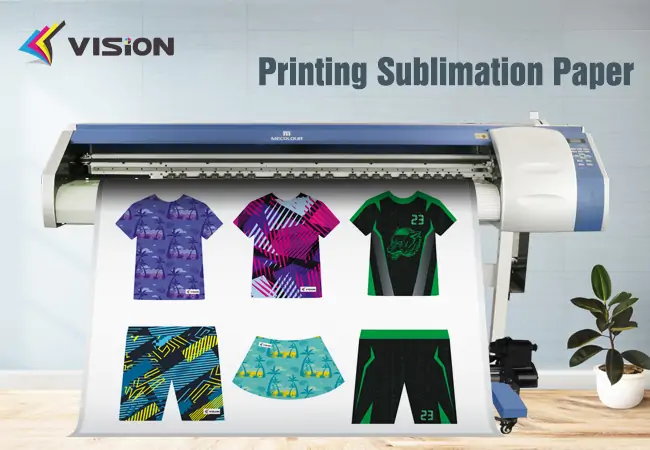
sticky sublimation paper printing
So, Is Thicker Sublimation Paper Better?
The best sublimation paper is not necessarily the thickest one—it is the one that matches your printing system and application.
For textile applications with high ink coverage, a heavier paper may provide better handling and ink management. For certain hard substrates or lighter-ink designs, a thinner paper may offer better control.
For manufacturers, importers, wholesalers, and print shops, the most reliable approach is to compare GSM + coating + drying + transfer rate + printer compatibility through actual testing.
At Vision, we offer different sublimation paper solutions for various printing requirements and applications. If you are sourcing sublimation paper for wholesale or production use, contact us with your printer model, ink type, substrate, and target application. We can help you identify a suitable paper specification and arrange samples for testing before bulk production.
Related:
70gsm vs 90gsm vs 100gsm Sublimation Paper: Best Choice?
Best Sublimation Paper for Beginners
Best Sublimation Paper Options for Tumblers
Knowing About The Best Sublimation Paper for T-shirts
The Different Types of Sublimation Paper and Their Features
Roll Size and Sheet Size of sublimation paper
Comparing Light Weight and Heavy Weight Sublimation Paper